

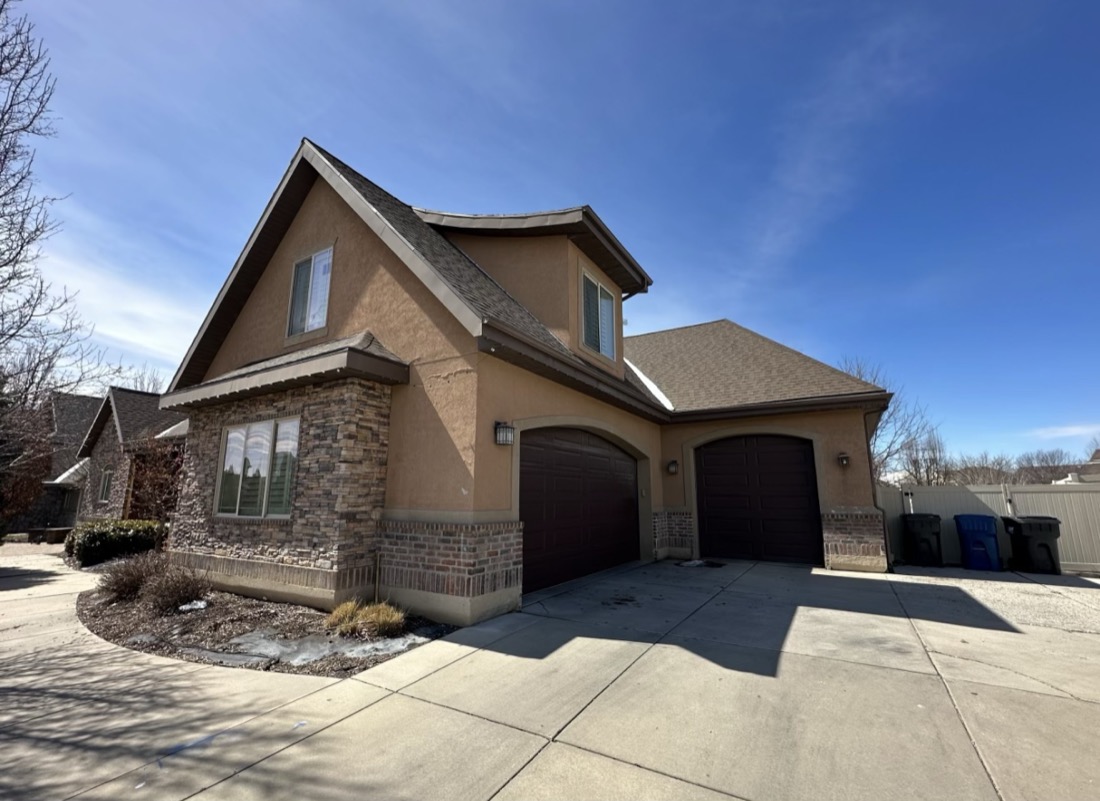
Stucco cracks get blamed on a lot of things – bad plaster work, a settling foundation, hail. But some of the most predictable cracking on Utah stucco homes isn’t a defect at all. It’s what happens when a wall is never given a planned place to move. That’s the job of a control joint, and on a surprising number of homes it’s either missing where it should be or quietly caulked shut by someone who mistook it for a crack.
What a Control Joint Actually Is
A control joint is a thin metal strip – usually shaped like a sideways “M” or a shallow “V” – embedded in the stucco at planned intervals across a wall. It’s installed before the finish coat goes on, running vertically or stepping horizontally through the plaster. Instead of one continuous, rigid skin of stucco covering an entire wall, the joint breaks that skin into separate panels that can each expand and contract slightly on their own.
Why Utah Walls Need Them
Stucco itself barely moves, but the wood framing behind it does. Utah’s swings from single-digit winter mornings to triple-digit summer afternoons push a home’s frame to expand and contract more over a year than most climates see. Add in the ordinary settling every house goes through, and a large, unbroken stucco wall has nowhere to release that stress. Without a control joint, the wall cracks anyway – it just happens wherever the stress is highest instead of at a spot engineered to handle it, and that’s usually a jagged diagonal crack through a window corner or a long run of unbroken wall.
Where They Belong
Control joints are supposed to show up at predictable places: breaking up large, uninterrupted wall panels, at changes in wall height or direction, where an addition ties into the original structure, and at floor lines on multi-story homes where framing shifts happen. On a number of newer Utah builds we’ve inspected, these joints were either spaced too far apart to do their job or skipped entirely on smaller wall sections where a builder assumed the cracking wouldn’t be noticeable.
The Caulked-Shut Joint Problem
Just as common as a missing joint is one that’s been sealed over. A control joint is designed to flex, but a homeowner – or sometimes a painter doing touch-up work – sees the gap and the exposed metal strip and assumes it’s damage that needs to be caulked and painted to match the wall. Once that gap is filled solid, the joint can’t do its job anymore. The wall is effectively back to being one rigid panel, and the stress that joint was supposed to absorb starts showing up as a crack somewhere nearby instead.
How to Tell What You’re Looking At
A real control joint runs in a straight, intentional line – usually vertical, sometimes stepping at a floor line – and the metal reveal stays visible and consistent along its length. A crack, by contrast, is irregular, often starts at a window or door corner, and doesn’t follow a clean line. If you’re not sure which one you’re looking at, or if a joint on your home has clearly been filled in, it’s worth having someone take a look before more cracking shows up around it.
If you’re planning a re-stucco, an addition, or just want a second opinion on cracking that keeps coming back in the same spot, reach out to Ridgeline Home Exteriors. We can tell you whether your control joints are doing their job, and fix the ones that aren’t.