

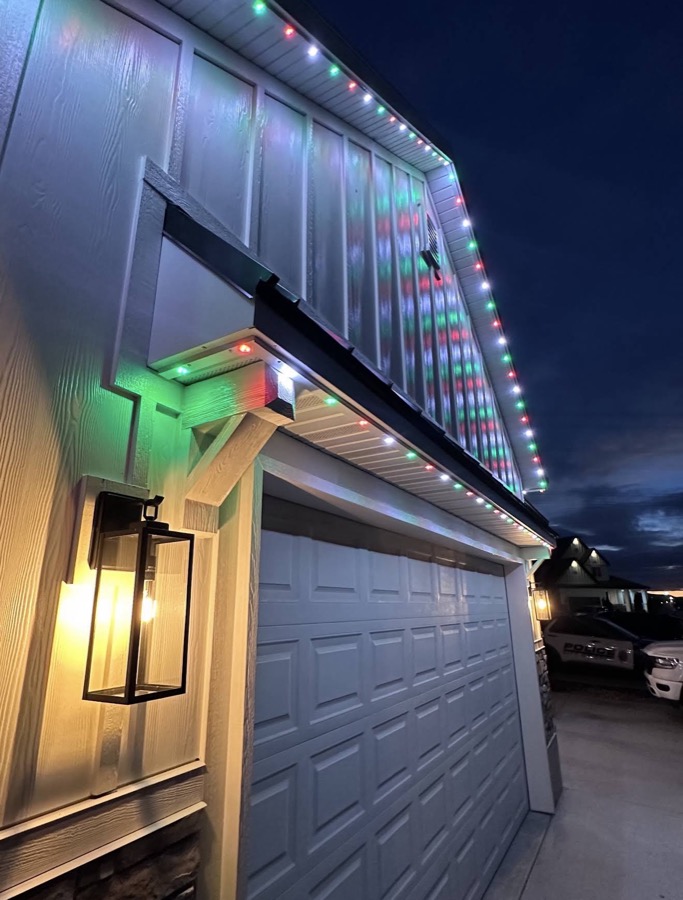
Permanent holiday lighting looks like the same low-profile channel system no matter whose house you’re looking at, but how it actually attaches depends a lot on what’s underneath it. Vinyl siding, fiber cement siding, and stucco all take the lighting channel differently, and an installer who treats every exterior the same way ends up with lights that sag, pull loose, or leave marks that outlast the holidays. Here’s what actually changes between them.
Vinyl and Fiber Cement Siding: Clips That Hook Into the Panel
Most siding profiles have a lip or a channel built into the panel itself, the same lip that hides the nailing strip above it. Permanent lighting clips are designed to hook into that lip, which means the channel can go on without a single screw or fastener touching the siding. It’s removable, it doesn’t puncture the panel, and it follows the horizontal lines of the siding cleanly. This is usually the simplest material to work with, and it’s why a lot of before-and-after photos for permanent lighting show it running along siding trim.
Stucco: No Lip to Grab, So the Channel Gets Fastened
Stucco doesn’t have a lip or a seam to clip onto, since it’s a continuous, hard surface. The lighting channel has to be mechanically fastened, usually with small masonry screws set along the roofline or trim boundary, or secured into fascia above it where fascia exists. Done correctly, those fasteners sit inside existing reveal lines or get sealed with color-matched caulking, the same way any other stucco penetration would be handled, so they’re not visible from the ground. Done poorly – or pulled out later by someone unfamiliar with stucco – those fastener points can turn into their own small entry points for water.
Fascia and Soffit Trim: The Cleanest Line, When It’s There
Where a home has exposed fascia board or a soffit return, that trim is often the preferred mounting surface no matter what the wall itself is made of. It’s flat, painted wood or aluminum rather than a textured surface, and clips seat into it the same way on a stucco home as on a siding home. Plenty of installs end up as a hybrid: fascia-mounted clips along most of the roofline, with stucco or siding only picking up the channel around dormers, gables, or other spots where there’s no fascia to use.
Mixing Materials on One Home Is the Norm in Utah
Plenty of homes here aren’t one material from top to bottom. Stucco on the main walls with siding accents in the gables is common, as is a stucco home with wood fascia trim and vinyl soffit panels. A single roofline can need two or three different mounting approaches, which is part of why a generic measurement from a catalog rarely holds up once someone’s actually on a ladder.
Why the Wrong Approach Causes Problems Later
The failures that show up later almost always trace back to the wrong mounting method for the surface underneath it – clips that were never designed for stucco getting glued on and popping off in a windstorm, or fasteners driven straight into vinyl siding that crack the panel once temperatures drop. Matching the mounting hardware to the actual wall material isn’t a cosmetic choice. It’s what keeps the system attached through a Utah winter instead of coming down with the first hard freeze-thaw cycle.
If you’re planning permanent holiday lighting and aren’t sure how it will mount to your particular mix of siding, stucco, or trim, contact Ridgeline Home Exteriors for a walkthrough. We look at your actual rooflines before quoting anything, so the system you get is the one built for your house.