

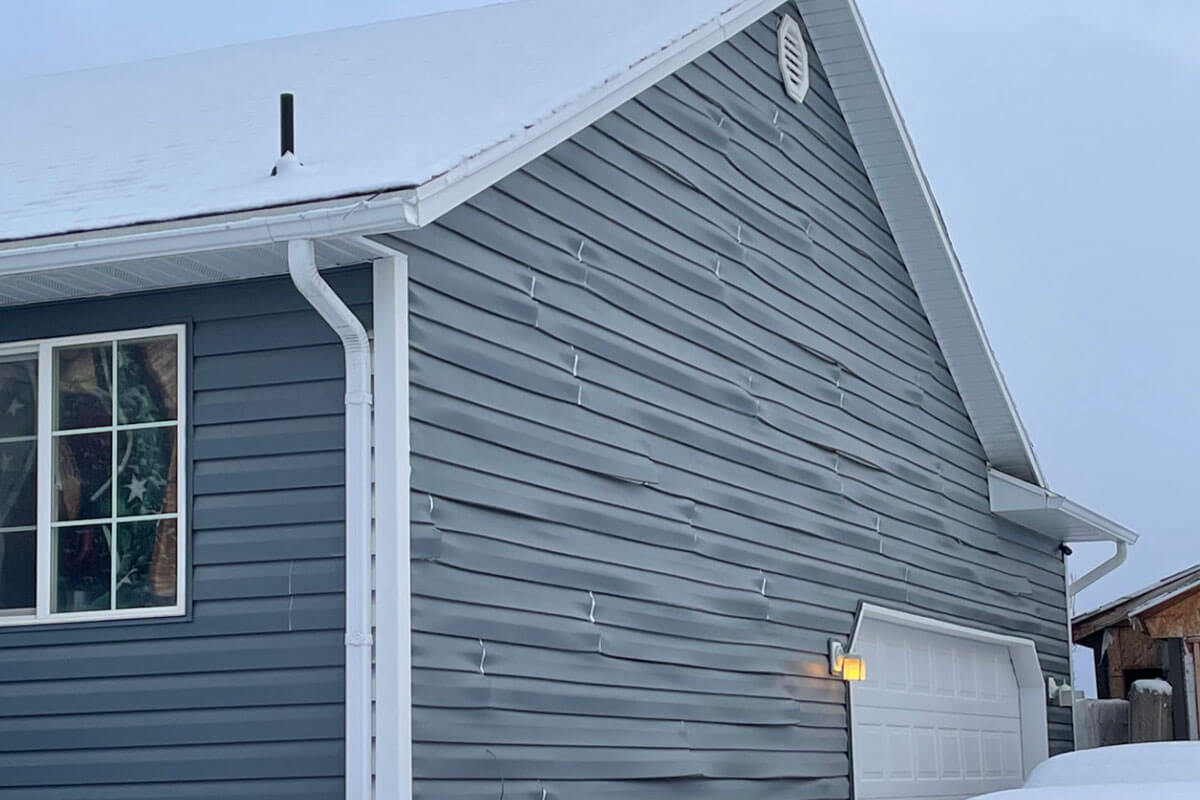
If you’ve noticed a section of your vinyl siding that looks wavy, bubbled, or like it was held near a heat source, your first thought is probably a defect or a nearby fire. In most cases it’s neither. It’s sunlight – specifically, sunlight bounced and concentrated by a modern energy-efficient window – and it’s a problem more Utah homeowners are running into as Low-E glass becomes the standard.
How Reflected Sunlight Melts Vinyl Siding
Vinyl starts to soften and warp around 160°F, well below what direct sun alone typically produces on a wall. The damage shows up when a nearby window – often a neighbor’s, sometimes your own – has a low-emissivity (Low-E) coating designed to reflect heat back outside for energy efficiency. Instead of scattering evenly, that coating can act like a magnifying glass, focusing reflected sunlight onto a narrow band of siding for a few hours a day. Over time, the concentrated heat is enough to warp, bubble, or discolor the panels in that exact spot.
Why This Shows Up More Often in Utah
Utah’s high elevation means more intense solar radiation reaching the ground than at sea level, and the state’s building boom over the past decade has put a lot of new Low-E windows into neighborhoods with houses built close together. The angle of the sun matters too. This kind of damage tends to show up in late summer and early fall, when the afternoon sun sits lower in the sky and lines up with windows that, earlier in the summer, were reflecting light harmlessly over the roofline. If you’re noticing new warping on your siding right now, the timing isn’t a coincidence.
How to Tell If This Is What’s Happening
Reflection damage has a distinct signature. It’s usually confined to one section of wall, often a rectangle or fan shape roughly the size and angle of the offending window’s reflection. It doesn’t spread evenly across a whole elevation the way ordinary sun fading does, and it tends to get worse at the same time each afternoon rather than being constant. Trace a line from the damaged siding back toward the sun’s afternoon position and there’s a good chance you’ll find a window – on your house, a neighbor’s, or even a parked vehicle at the right angle – sitting right in that sightline.
What You Can Do About It
Because this isn’t a manufacturing defect, it’s usually not covered under a standard siding warranty, and it can be an awkward conversation if the source window belongs to a neighbor. A few things actually work: applying a UV-blocking or anti-reflective film to the offending window, adding an awning or landscaping that blocks the reflection’s path, or replacing the affected siding section outright. Darker vinyl colors absorb more heat and are more prone to this kind of damage, so if the reflection exposure can’t be eliminated, switching that section to a fiber cement product like James Hardie siding – which won’t warp from heat the way vinyl can – is often the more permanent fix.
If you’re seeing warped or bubbled siding on your home, we can help you figure out the actual cause before recommending a fix, whether that means a patch repair, a full section replacement, or a switch to a more heat-tolerant material. Contact Ridgeline Home Exteriors for a free inspection and estimate.