

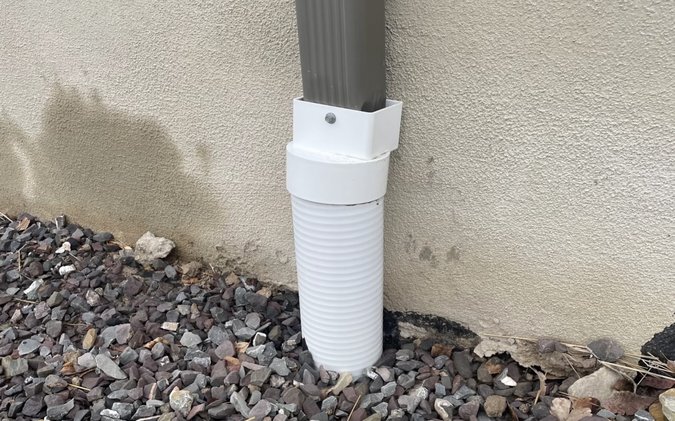
Standing water a few feet from a downspout isn’t the same problem as standing water at your foundation – but from the middle of the yard, they can look identical. Before assuming you need a full French drain system, it’s worth understanding what a simple downspout extension can and can’t fix, because the right answer for a Utah yard usually comes down to grading and soil, not how much you’re willing to spend.
The Cheapest Fix: Downspout Extensions
A downspout extension is a length of solid or flexible pipe that carries water a few extra feet past the foundation before releasing it onto the surface of the yard. It’s inexpensive, takes an afternoon to install, and works well when your lot slopes away from the house and the new discharge point is genuinely lower than your foundation. The catch is that it only relocates the water – it doesn’t get rid of it. If that spot is still relatively flat, or close to a neighbor’s property line, you’ve just moved the puddle instead of solving it.
When a Dry Well Bridges the Gap
A dry well is a buried, gravel-filled pit that a downspout extension or a short drain line empties into. Instead of dumping water on the surface, it lets water percolate slowly into the soil below. Dry wells work well where the yard is nearly flat and there’s no good low point to run a pipe to. In Utah’s clay soil, though, a dry well has to be sized generously – clay absorbs water far slower than sandy soil, so an undersized one just fills up and backs out during a hard storm.
When You Need a Full French Drain
A French drain – a trench of perforated pipe wrapped in gravel and fabric – earns its cost when water is a whole-yard problem rather than a single-downspout problem: a soggy strip that runs the length of your foundation, water finding its way into a crawl space or basement, or several low points that all need to route to the same discharge location. Because the pipe is buried below grade and can run wherever the yard needs it to, it’s the only option that reliably handles groundwater as well as roof runoff – something an extension or a single dry well was never designed to do.
Read Your Yard’s Grading Before You Choose
The deciding factor is almost always grading, not the size of the storm. Walk your yard the day after heavy rain or spring snowmelt and note where water actually sits. If it’s only near the downspouts and drains away within a few hours, an extension is probably enough. If it lingers for a day or more, especially along the foundation, that’s water sitting on clay that can’t absorb it – and that calls for a system built to move it away, not just relocate it a few feet.
Signs an Extension Won’t Be Enough
A few warning signs mean it’s time to stop patching and start planning: water still pooling within ten feet of the house after every storm, a musty smell or dampness in a basement or crawl space, cracked or heaving concrete near the foundation, or a yard that stays wet for days after Utah County’s spring runoff or a St. George monsoon downpour. Any one of these usually means the water has more places to go than a single extension can handle.
We evaluate each yard’s grading, soil, and downspout layout before recommending anything – sometimes that’s a simple extension, sometimes it’s a dry well, and sometimes it’s a full in-ground drainage system tied into your gutters. If your yard is holding water longer than it should, reach out to Ridgeline Home Exteriors for a free evaluation, and we’ll tell you honestly which one your home actually needs.